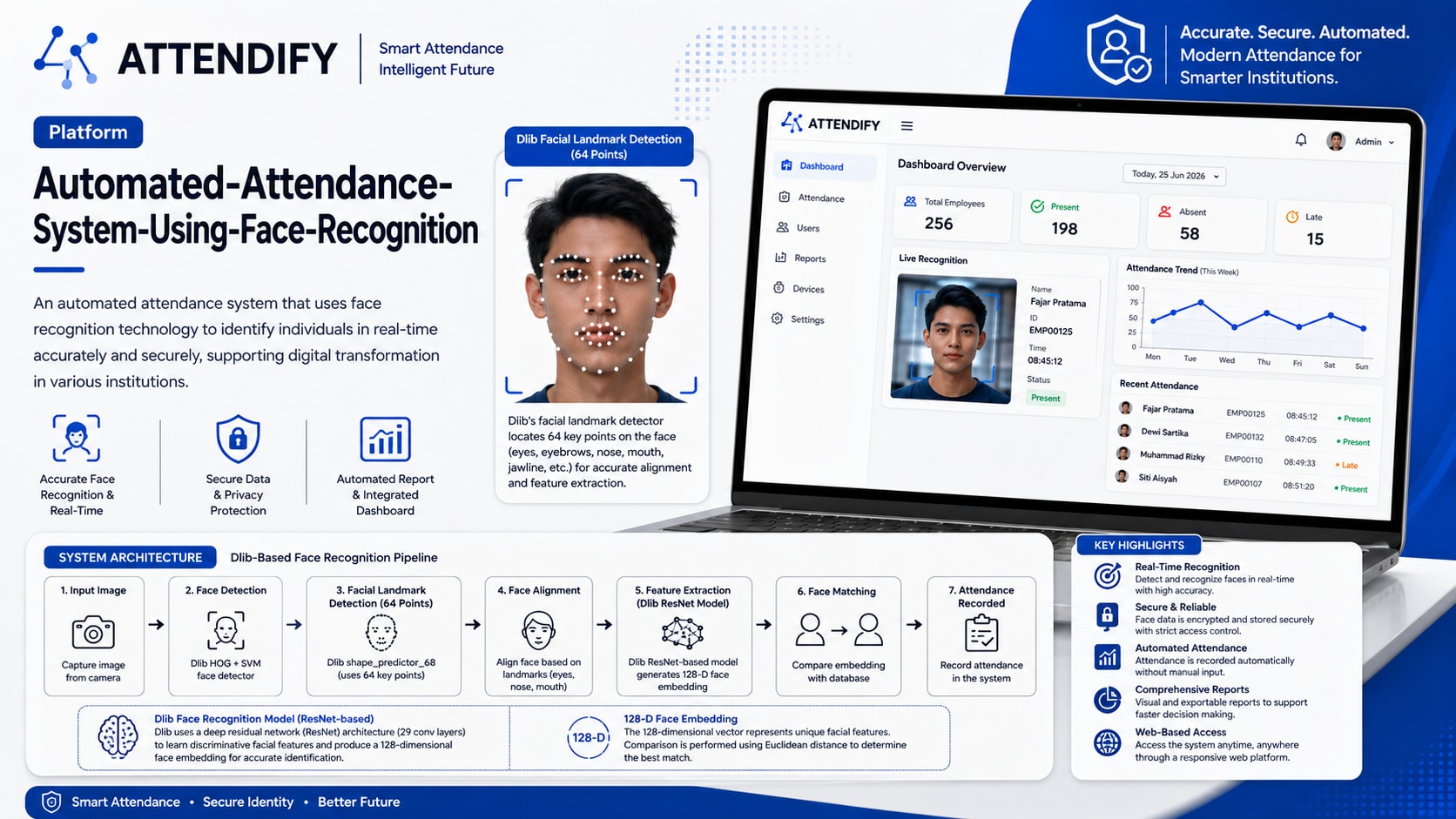
Automated Attendance System Using Face Recognition
Automated Attendance System Using Face Recognition is a web-based attendance solution powered by Computer Vision, Dlib Facial Landmark Detection, and Dlib's ResNet-based Face Recognition Model. It performs real-time face recognition and automatically records attendance with high accuracy, enhanced security, and improved operational efficiency.
View Live ProjectShare this:
PROJECT OVERVIEW
Attendance Vision is an automated attendance system based on face recognition that uses a webcam to detect and recognize faces in real time. The system matches detected faces with facial data stored in the training folder, then automatically records attendance information in a CSV file.
This project combines computer vision, face recognition, and data processing technologies to accelerate the attendance process, reduce manual recording, and generate attendance data that can be analyzed further.
CASE STUDY AND SCOPE
The case study of this project focuses on the attendance process for students or employees using facial recognition.
The project scope includes:
Reading and processing facial images from the training folder.
Extracting student ID numbers and names from image filenames.
Generating and storing face encodings.
Detecting faces in real time through a webcam.
Comparing detected faces with the training data.
Recording names, attendance times, and attendance statuses.
Assigning PRESENT or LATE status based on a predefined time limit.
Storing face recognition logs.
Displaying accuracy visualizations and attendance summaries.
TECHNOLOGY STACK
Python
Used as the primary programming language for developing the entire system.
OpenCV
Used to access the webcam, read video frames, display detection results, and draw labels around detected faces.
face_recognition
Used to detect faces, generate face encodings, and perform facial matching.
dlib
Used as the main engine for the face recognition process. The model used is dlib_face_recognition_resnet_model_v1.dat, which is a ResNet-based face recognition model.
NumPy
Used for array processing and numerical operations on face encoding data.
Pandas
Used to read, process, and store attendance data and recognition logs in CSV format.
Matplotlib
Used to create accuracy visualizations and attendance summary charts.